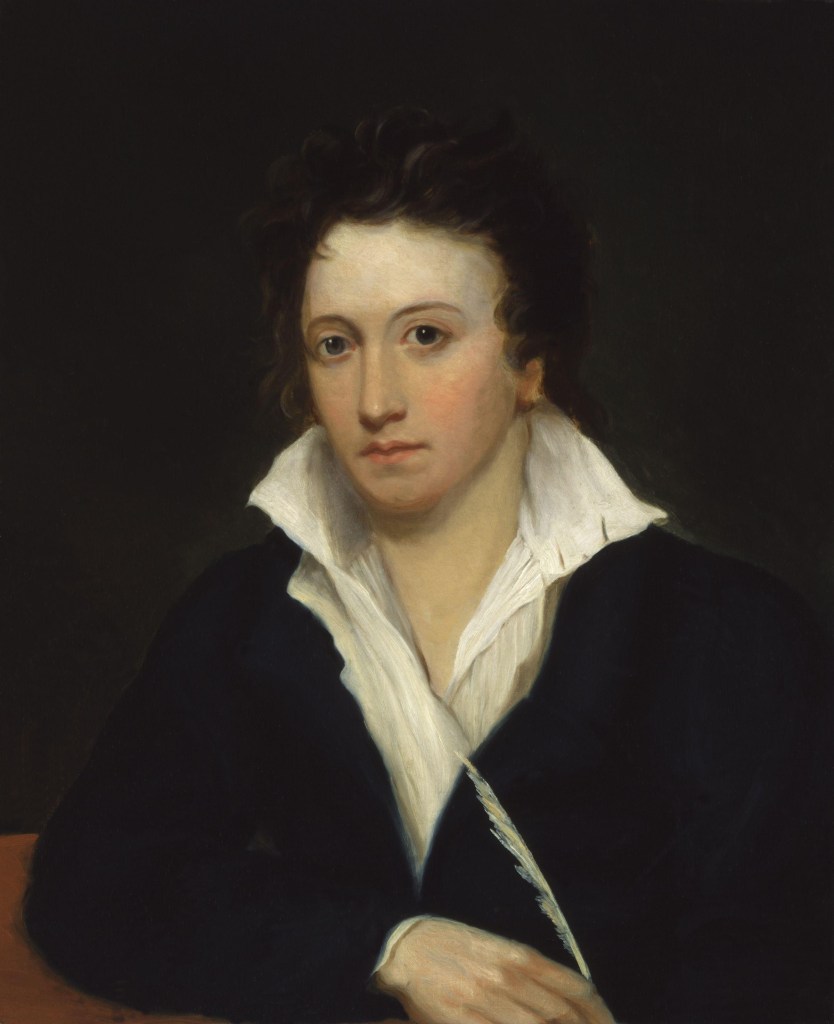
If Lord Byron was the rock star of Romanticism, swirling in scandal like a poetic Mick Jagger, Percy Bysshe Shelley (1792–1822) was the anarchic punk rocker.
He didn’t want to entertain the system; he wanted to smash it to bits—preferably with a megaphone in one hand and a copy of The Necessity of Atheism in the other. A furious, dangerously smart idealist, Shelley didn’t just talk about change; he wanted to torch the old order and draft a brand-new utopia from the ashes. Why settle for polite reform when you can ignite a revolution in every courtroom, cathedral, and drawing room?
The Trust Fund Rebel Born into a wealthy, politically connected family, Shelley was the archetype of the privileged misfit.
Imagine the earnest, bespectacled teenager at Eton, getting bullied not for being weak, but for being too radical. He was nicknamed “Mad Shelley” because what else do you call a teenager who openly preaches atheism, vegetarianism, and the overthrow of the government?
At Oxford, he co-wrote a pamphlet titled The Necessity of Atheism—probably setting a record for the “fastest expulsion” in university history. This wasn’t a debate club topic; it was a full-on intellectual middle finger to the establishment, blazing a trail for the rest of his tempestuous life.
Life as a Riotous Manifesto: Shelley didn’t just keep his revolution on paper. He practised what he preached—with varying degrees of chaos.
He eloped with the 16-year-old Mary Godwin (leaving behind a trail of shocked relatives and a scandalous amount of debt). He championed “free love” and vegetarianism before it was cute, advocated for Irish independence, and racked up enemies across Europe. To the buttoned-up Regency crowd, he was less a poet and more a walking, talking diplomatic incident.
But his radicalism was sincere. It wasn’t just teen angst; it was a vision of a future where reason and love dethroned tyranny. The tragedy was that, being both a fierce dreamer and a walking hazard, he lived his life in exile, forever chasing a horizon that kept moving just out of reach.
Poetry as a Molotov Cocktail. To Shelley, poetry wasn’t about pretty words; it was a weapon. He famously declared that poets were the “unacknowledged legislators of the world,” meaning a sharp verse could do what parliament endlessly bungled: inspire seismic change.
His pamphlet The Masque of Anarchy was a blistering response to the 1819 Peterloo Massacre, where government cavalry charged down peaceful protestors. Far from a tame elegy, Shelley’s poem was a rallying cry for non-violent resistance:
“Rise like Lions after slumber In unvanquishable number, Shake your chains to earth like dew… Ye are many—they are few.”
It is a cheerleader poem for the oppressed, sparking revolution not with bullets but with the terrifying realisation of numbers.
But his savvy went deeper than fiery calls to arms; he understood that power decays. His masterpiece, Ozymandias, is a 14-line time bomb aimed at any ruler, CEO, or dictator foolish enough to think their reign will last forever. That shattered statue in the desert is Shelley’s way of saying: “Your empire? Dust.” It is a poetic mic drop on the concept of hubris.
Unsurprisingly, a life spent in unapologetic rebellion comes with a high cost. Shelley died young—drowned in a sailing accident in Italy just shy of 30, as if the universe decided it had tolerated enough of his insubordination. His life was already a storm before the sea claimed him: turmoil, family estrangement, scandal, and grief shadowed him long before the final wave did.
Yet from within that chaos, he forged a language of defiance that future generations of radicals would inherit like contraband scripture. Shelley understood something terrifyingly simple: ideas are dangerous things. They can be drowned, burned, censored, exiled—but they refuse to die. And that, in the end, is the tragedy of Shelley: he was right. Absolutely, devastatingly right. The powerful are few; the oppressed are many. Empires do crumble into dust. History does bend—but not fast enough to save the people crushed beneath it.
And here lies the knife twist. Being right and being effective are not the same thing. Shelley’s poetry inspired revolutionaries long after his death, but it didn’t stop the next massacre. It didn’t prevent the next war. It didn’t topple a single throne in his lifetime. He died at 29: exiled, estranged from his family, and largely dismissed by the establishment he spent his life attacking.
His life leaves us with a brutal question, one he never lived long enough to answer: If the most brilliant radical of his age couldn’t change anything, what makes us think we can?
 Midnight Moon's Library