Romanticism’s Unpaid Interns and Invisible Architects
So far, we’ve met the rock stars of Romanticism.
We’ve had Blake, the visionary prophet, shredding a solo against the cosmos; Wordsworth, the introspective frontman singing acoustic ballads to flowers; and Coleridge, the erratic keyboardist dreaming up psychedelic masterpieces in a drug-fueled haze.
It’s a great lineup. But like any famous band, for every lead basking in the spotlight, there is a team in the shadows writing the lyrics, designing the set, and inventing the genre.
The history of Romanticism is usually told as a story about men. But the currents that defined the movement were profoundly shaped by women who, because they dared to be born female in a male-centric world, were relegated to the footnotes. They were the philosophers who wrote the manifestos, the muses who provided the raw data, and the architects who built the stages on which men later performed.
Let’s meet the invisible staff.
1. Mary Wollstonecraft: The Woman Who Argued That Women Have Brains Before the Romantics could get excited about the “power of the individual,” someone had to do the hard work of arguing that all individuals—including the half of the population inexplicably ignored—actually mattered. That person was Mary Wollstonecraft (1759–1797).
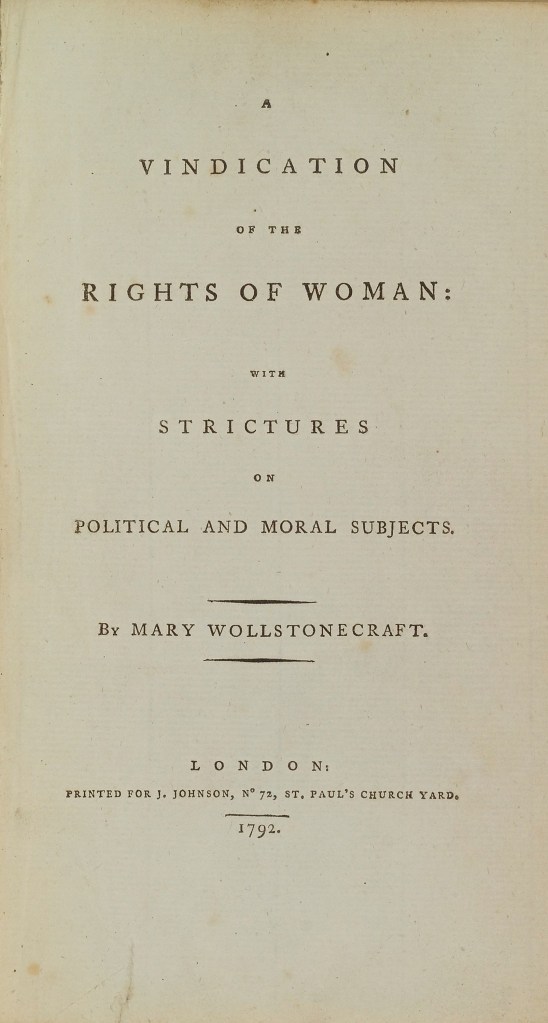
With her incendiary 1792 book, A Vindication of the Rights of Woman, Wollstonecraft exposed the glaring hypocrisy of the Enlightenment’s lofty ideals of reason and liberty. While men were patting themselves on the back for being rational creatures, society was actively raising women to be frivolous, emotionally unstable ornaments.
Her argument was as simple as it was revolutionary: This is a waste.
Women, she insisted, are rational beings, not just walking bundles of feelings. Give them the same education as men, and they will become better citizens. The entire Romantic obsession with the authentic, self-determining individual owes a massive debt to her. How can you champion the inner life if half of humanity is denied one by law? Wollstonecraft built the philosophical launchpad from which the movement took flight.
Of course, her reward for this intellectual heavy lifting—combined with an unconventional life—was to be branded a scandalous radical. This made it frightfully convenient for the establishment to dismiss her arguments while quietly stealing her ideas.
2. Dorothy Wordsworth: The Unpaid Researcher If Mary Wollstonecraft provided the philosophy, Dorothy Wordsworth (1771–1855) provided the raw data.
The quiet, fiercely intelligent sister of the great William Wordsworth, Dorothy was the unpaid, uncredited, and essential collaborator in his career. Her detailed, lyrical journals were the wellspring from which her brother drew his inspiration.
The most famous example is the daffodils. On April 15th, 1802, Dorothy wrote in her journal about a walk she took with William:
“I never saw daffodils so beautiful… some rested their heads upon these stones as on a pillow for weariness, and the rest tossed and reeled and danced and seemed as if they verily laughed with the wind…”
Two years later, William published his version, I Wandered Lonely as a Cloud, complete with “a host of golden daffodils… Tossing their heads in sprightly dance.”
He didn’t just borrow the image; he borrowed the soul of the observation. This was her lived experience, her emotional and sensory data, repackaged under his name. And it wasn’t a one-off. She was, in modern corporate parlance, the brilliant researcher who does all the work for which the male boss takes the credit and the bonus.
3. Ann Radcliffe: The Woman Who Made Terror Fashionable While the Wordsworths were busy with flowers, a different kind of revolution was happening in the literary marketplace, led by Ann Radcliffe (1764–1823).
Radcliffe was the Queen of Goth. She was a commercial powerhouse who turned a niche genre into an international sensation. With blockbuster novels like The Mysteries of Udolpho, she perfected the formula that would define dark Romanticism: a sensitive heroine trapped in a crumbling, sublime landscape, tormented by a brooding, mysterious villain.
Sound familiar? Radcliffe essentially built the aesthetic toolkit for the “Byronic Hero.” Lord Byron’s moody, wandering outcasts are just Ann Radcliffe’s villains given a slightly better wardrobe and a book of poetry.
She mastered the art of suspense, creating atmospheres of such intense dread that the whole of England was hooked. Yet, because she was a woman writing popular fiction, she was dismissed as a mere entertainer. The men who followed, using the very tropes she invented, were hailed as profound explorers of the human soul. Ann Radcliffe built the haunted stage; she just let the boys think they discovered the darkness all by themselves.
4. Anna Laetitia Barbauld: The Godmother. They Ghosted. Before the new wave of Romantics could become famous, someone had to be accepted by the literary establishment. That person was Anna Laetitia Barbauld (1743–1825). A hugely respected poet and essayist, she was a gatekeeper whose opinion mattered.
And, as it turns out, the new boys’ club didn’t like her feedback.
The famous story involves a young Coleridge showing her an early draft of The Rime of the Ancient Mariner. Barbauld, a brilliant rationalist, reportedly told him the poem was magnificent but had two faults: “it was improbable, and had no moral.”
From her perspective, this was a sensible critique. From Coleridge, it was a failure to appreciate his genius. He and his friends never forgave her. They later used this story to paint her as a stuffy, old-fashioned critic who “didn’t get it.” They effectively wrote her out of the movement’s history, ghosting the literary godmother who had helped shape the scene.
The Verdict: These women were not just adjacent to the Romantic movement; they were its engine room. They laid the foundations, provided the creative material, and shaped the genres. The official history is just another story written by the winners—and like all the best stories, it is in desperate need of a bit of mending.
 Midnight Moon's Library