
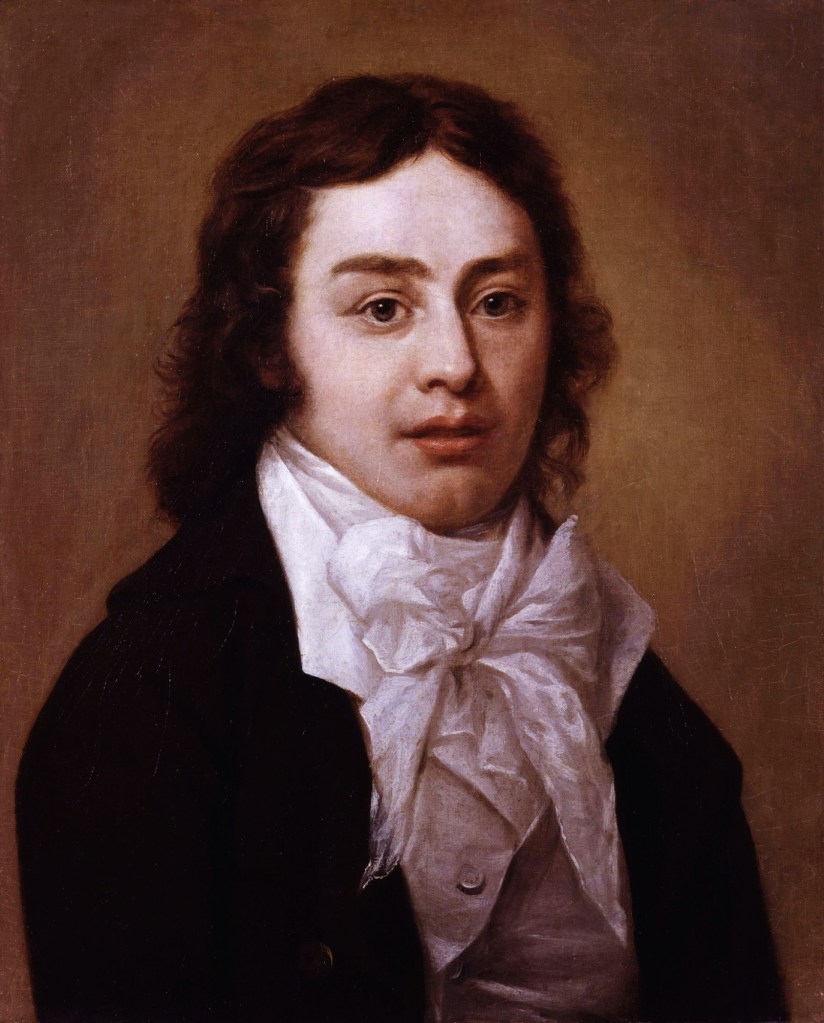
The Haunted Dreamer (And the Person from Porlock)
If William Wordsworth was the sober hiker of Romanticism, finding God on a misty mountaintop, Samuel Taylor Coleridge (1772–1834) was the man who stayed indoors, took too much laudanum, and met a ghost.
While Wordsworth looked out at the Lake District and saw a sanctuary, Coleridge looked inward and found a far stranger wilderness: the landscape of the human imagination. It was a place of sea monsters, vampire ladies, and pleasure domes that vanished at the slightest interruption. He didn’t map the hills; he mapped the nightmares.
Revolutionary Fervour, Utopian Hangover. Like his friend Wordsworth, Coleridge was initially swept up in the rush of the French Revolution. It was a grand idea, full of righteous anger. But as the dream of liberty curdled into the reality of the guillotine, Coleridge’s revolutionary spirit didn’t just retreat; it got weird.
His solution was a scheme called “Pantisocracy,” a fancy Greek word for “equal rule by all.” The plan? Grab a dozen intellectuals, sail to the wilds of Pennsylvania, and found a perfect commune based on philosophy and communal farming.
It was a beautiful, brilliant, and utterly ridiculous idea. It collapsed—as utopian schemes usually do—under the crushing weight of reality. Specifically, the realisation that while poets are great at discussing liberty, they are generally terrible at deciding who has to do the washing up.
The Magic Trick of the Modern World. Disappointed with political solutions, Coleridge turned his attention to the mind. In doing so, he gave a name to the magic trick that makes all modern entertainment possible: “The willing suspension of disbelief.”
It sounds academic, but it is the secret ingredient that powers every Netflix binge, every Marvel movie, and every horror novel. It is that unspoken contract in which we agree to shut off our rational, cynical brains and believe that the undead can crew a ghost ship or that a billionaire can fly in a metal suit. Before Coleridge, that was just “lying.” After him, we understood that the imagination wasn’t a passive receiver of stories, but an active co-conspirator.
The Supernatural as Super-Nature Coleridge put this theory to work in his masterpiece, The Rime of the Ancient Mariner. (And yes, for the metalheads in the back, thank you, Iron Maiden, for keeping the syllabus alive).
This is not a gentle poem about nature. It is a full-blown psychedelic horror story. A sailor commits one, seemingly small, act of cruelty—shooting an albatross—and the entire cosmos rises to punish him. The sun becomes a curse, the ocean rots, and the spirits of the deep come to collect.
This was Coleridge’s version of an environmental warning. It wasn’t Wordsworth’s calm assurance that a walk by the lake would make you a better person. It was a terrifying vision of a world where nature is a living, breathing, and vengeful force. He argued that our connection to the world wasn’t a scenic view; it was a sacred bond. Break it, and the world breaks you.
The Man from Porlock: Our Modern Condition Perhaps nothing captures Coleridge’s genius—and his tragedy—better than the story of Kubla Khan.
Under the influence of opium (painkillers were more potent in the 1790s), he fell into a profound dream and saw a magnificent pleasure dome. He awoke and began writing it down frantically, the words flowing in a torrent of perfect inspiration. And then… There was a knock at the door.
It was a “person from Porlock” on some mundane business. By the time the visitor left, the dream was gone. The vision shattered, leaving only a fragment.
That interruption has become a legend. It is also the perfect metaphor for the modern mind. We are capable of accessing paradise, only to be dragged back by the tedious demands of the real world. In an age of constant notifications, breaking news alerts, and the “ping” of emails, we are all living in a house full of People from Porlock.
Coleridge understood that the most sublime visions are also the most fragile. If Wordsworth’s advice were “go for a walk,” Coleridge’s would be “go for a walk—but bring your nightmares, your imaginary friends, and your anxiety along for company.”
 Midnight Moon's Library